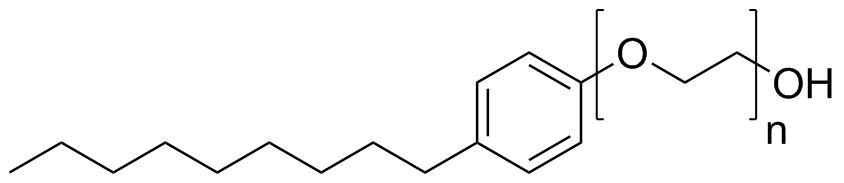
Nonylphenoxypoly(ethyleneoxy)ethanol is a nonionic surfactant belonging to the alkylphenol ethoxylate (APE) family. It is composed of a hydrophobic nonylphenyl group linked through an ether bond to a poly(ethylene oxide) chain of variable length, typically written as nonylphenol ethoxylate with an average number of ethylene oxide units (–CH2CH2O–)n. The value of n is not fixed and represents a distribution of homologous molecules rather than a single defined compound.
The molecular structure consists of three main components: a nonyl group (C9H19) attached to a phenoxy ring, which forms the hydrophobic tail; a phenyl ring that provides structural rigidity and aromatic character; and a polyoxyethylene chain that serves as the hydrophilic head group. This amphiphilic architecture enables strong surface-active behavior, allowing the molecule to interact with both hydrophobic and aqueous phases.
The compound is produced by the ethoxylation of nonylphenol, which itself is synthesized by the alkylation of phenol with nonene-derived nonyl groups. In the ethoxylation step, ethylene oxide is added under alkaline catalytic conditions to the phenolic oxygen atom, forming ether linkages and extending the hydrophilic chain. The degree of ethoxylation is controlled by reaction conditions, resulting in products with different solubility and surfactant properties.
Nonylphenoxypoly(ethyleneoxy)ethanol functions as a nonionic surfactant. In aqueous solution, it does not dissociate into ions, which makes it relatively insensitive to water hardness and electrolyte concentration. Its amphiphilic structure allows it to adsorb at interfaces, reducing surface and interfacial tension. Above the critical micelle concentration, it forms micelles that can solubilize oils, organic compounds, and other hydrophobic substances.
This class of surfactants has been widely used in industrial applications, including emulsifiers, wetting agents, detergents, dispersants, and solubilizers. It is commonly found in textile processing, agrochemical formulations, industrial cleaning agents, and emulsion polymerization processes. In these applications, it helps stabilize emulsions and improve the dispersion of hydrophobic materials in water-based systems.
The performance of nonylphenoxypoly(ethyleneoxy)ethanol depends strongly on the length of the ethoxylate chain. Lower ethoxylation levels result in more hydrophobic, oil-soluble surfactants, while higher ethoxylation increases water solubility and emulsification capacity. This tunability makes the compound useful across a wide range of formulation requirements.
From a physicochemical perspective, the aromatic nonylphenol group provides strong hydrophobic interaction and interfacial adsorption, while the polyoxyethylene chain contributes hydrogen bonding interactions with water. This balance determines properties such as cloud point, solubility, foaming behavior, and emulsification efficiency.
Historically, alkylphenol ethoxylates were widely used due to their strong surfactant performance and cost-effectiveness. However, concerns have been raised about their environmental persistence and degradation products, particularly nonylphenol, which can exhibit endocrine-disrupting activity in aquatic environments. As a result, their use has been increasingly restricted or replaced in many regions by more biodegradable nonionic surfactants such as alcohol ethoxylates.
Overall, nonylphenoxypoly(ethyleneoxy)ethanol is a nonionic surfactant consisting of a nonylphenol hydrophobic group and a poly(ethylene oxide) hydrophilic chain. Its amphiphilic structure provides effective emulsifying, wetting, and dispersing properties, making it historically important in industrial chemistry, although environmental concerns have led to reduced use in many modern applications.
|







 GHS07 Warning Details
 chemBlink Chemical Story