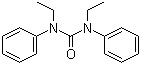
1,3-Diethyl-1,3-diphenylurea is better known in energetic-materials literature as ethyl centralite. Its role is counterintuitive: it is added to nitrocellulose-based propellant formulations not primarily to make them more energetic, but to slow the chemical processes by which they become unsafe during long storage. It is therefore a stabilizer - a molecule whose consumption can reveal the aging of the material it protects.
Nitrocellulose and nitrate-ester ingredients undergo slow decomposition even under ordinary storage conditions. Reactive nitrogen oxides and acidic species produced during this process can accelerate further decomposition, creating an autocatalytic cycle. Stabilizers interrupt that cycle by reacting with or scavenging reactive decomposition products. Ethyl centralite, with two N-ethyl-N-phenyl substituents around a urea carbonyl, can undergo nitrosation and related transformations instead of allowing reactive nitrogen species to continue attacking the energetic matrix.
This means the stabilizer itself changes with time. Analytical studies have identified ethyl-centralite transformation products and used chromatography and mass spectrometry to follow stabilizer depletion. The amount of parent stabilizer remaining is therefore not merely a formulation number; together with degradation products and other measurements, it becomes evidence about chemical age. Modern surveillance of propellants relies on such analytical chemistry because visual appearance alone cannot show the state of slow molecular decomposition.
Ethyl centralite can also influence physical properties and combustion behavior in formulations, but its stabilizing function is the scientifically distinctive one. The chemistry illustrates a general materials principle: a sacrificial additive can protect a much larger mass of material by preferentially reacting with a small but dangerous population of reactive species. Similar ideas appear in antioxidants for polymers and fuels, although the reaction chemistry differs.
Ethyl centralite matters because it turns molecular consumption into a safety signal. The stabilizer is expected to react; complete inertness would defeat its purpose. As it is gradually converted into derivatives, analysts gain a chemical clock for aging. This makes ethyl centralite an unusual additive whose disappearance is part of its function - and a reminder that long-term material safety can depend on tracking reactions occurring far too slowly to see.
References:
Druet L, Angers J. Propellants, Explosives, Pyrotechnics. 1988;13:87-94. DOI: 10.1002/prep.19880130306.
Trache D et al. Critical Reviews in Analytical Chemistry. 2018;48:201-221. Stabilizer analysis and aging of nitrate-ester energetic materials.
General surveillance literature on ethyl centralite stabilized nitrocellulose propellants.
|






 GHS07 Warning Details
 chemBlink Chemical Story