
Online Database of Chemicals from Around the World
| Zhejiang Kangfeng Chemicals Co., Ltd. | China | |||
|---|---|---|---|---|
 | www.kangfeng.com | |||
 | +86 (579) 8670-9298 8670-9155 | |||
 | +86 (579) 8670-9678 | |||
 | wukang@kangfeng.com qimaoxin@kangfeng.com | |||
| Chemical manufacturer since 1995 | ||||
| chemBlink Standard supplier since 2008 | ||||
| Simagchem Corporation | China | |||
|---|---|---|---|---|
| www.simagchem.com | |||
| +86 13806087780 | |||
| +86 (592) 268-0237 | |||
| sale@simagchem.com | |||
| Chemical manufacturer since 2002 | ||||
| chemBlink Standard supplier since 2008 | ||||
| Hefei TNJ Chemical Industry Co., Ltd. | China | |||
|---|---|---|---|---|
| www.tnjchem.com | |||
| +86 (551) 6541-8684 | |||
| +86 (551) 6541-8697 | |||
| sales@tnjchem.com | |||
| Chemical manufacturer since 2001 | ||||
| chemBlink Standard supplier since 2010 | ||||
| BOC Sciences | USA | |||
|---|---|---|---|---|
| www.bocsci.com | |||
| +1 (631) 485-4226 | |||
| +1 (631) 614-7828 | |||
| info@bocsci.com | |||
| Chemical manufacturer | ||||
| chemBlink Standard supplier since 2010 | ||||
| LinkChem Shanghai Co., Ltd. | China | |||
|---|---|---|---|---|
| www.linkchem.cn | |||
| +86 (21) 5895-0110 +86 13391192982 | |||
| +86 (21) 2022-2982 | |||
| sales@linkchem.cn | |||
| Chemical manufacturer | ||||
| chemBlink Standard supplier since 2011 | ||||
| Hangzhou Leap Chem Co., Ltd. | China | |||
|---|---|---|---|---|
| www.leapchem.com | |||
| +86 (571) 8771-1850 | |||
| market19@leapchem.com | |||
 | QQ Chat | |||
| Chemical manufacturer since 2006 | ||||
| chemBlink Standard supplier since 2015 | ||||
| Shanghai Future Industrial Limited By Share Ltd. | China | |||
|---|---|---|---|---|
| www.jonln.com | |||
| +86 400-0066-400 | |||
| +86 (21) 5566-0885 | |||
| sales@jonln.com | |||
| Chemical distributor since 2011 | ||||
| chemBlink Standard supplier since 2015 | ||||
| Neostar United (Changzhou) Industrial Co., Ltd. | China | |||
|---|---|---|---|---|
| www.neostarunited.com | |||
| +86 (519) 8555-7386 +86 18015025600 | |||
| +86 (519) 8555-7389 | |||
| marketing1@neostarunited.com | |||
| Chemical distributor since 2014 | ||||
| chemBlink Standard supplier since 2020 | ||||
| INA Pharmaceuticals Pvt. Ltd. | India | |||
|---|---|---|---|---|
| inapharma.in | |||
| +91 7815933367 | |||
| rd@inapharma.in | |||
| Chemical manufacturer since 2018 | ||||
| chemBlink Standard supplier since 2026 | ||||
| Ricci Chimica | Italy | |||
|---|---|---|---|---|
| www.riccichimica.com | |||
| +39 (75) 692-9241 | |||
| +39 (75) 592-6595 | |||
| info@riccichimica.com | |||
| Chemical manufacturer | ||||
| Jiangsu Fenghua Chemical Co., Ltd. | China | |||
|---|---|---|---|---|
| www.fhchem.com | |||
| +86 (515) 8855-1818 | |||
| +86 (515) 8856-2028 | |||
| sales@fhchem.com | |||
| Chemical manufacturer | ||||
| Changzhou Suntton Co., Ltd. | USA | |||
|---|---|---|---|---|
| www.suntton.com | |||
| +1 (914) 965-2077 +86 (519) 8513-6089 | |||
| +1 (914) 375-2093 / +86 (519) 8513-6133 | |||
| luke.verdet@suntton.com lily.chen@suntton.com | |||
| Chemical manufacturer | ||||
| Kingchem Inc. | USA | |||
|---|---|---|---|---|
| www.kingchem.com | |||
| +1 (800) 211-4330 (201) 825-9988 | |||
| +1 (201) 825-9148 | |||
| customer-service@kingchem.com | |||
| Chemical manufacturer since 1994 | ||||
| Classification | Organic raw materials >> Organic fluorine compound >> Fluorotoluene series |
|---|---|
| Name | 3-Nitrobenzotrifluoride |
| Synonyms | 1-Nitro-3-(trifluoromethyl)benzene; 3-Nitro-alpha,alpha,alpha-trifluorotoluene; alpha,alpha,alpha-Trifluoro-3-nitrotoluene |
| Molecular Structure | 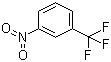 |
| Molecular Formula | C7H4F3NO2 |
| Molecular Weight | 191.11 |
| CAS Registry Number | 98-46-4 |
| EC Number | 202-670-1 |
| SMILES | C1=CC(=CC(=C1)[N+](=O)[O-])C(F)(F)F |
| Density | 1.4±0.1 g/cm3 Calc.*, 1.436 g/mL (Expl.) |
|---|---|
| Melting point | -5 °C (Expl.) |
| Boiling point | 202.8 °C 760 mmHg (Calc.)*, 201 - 205 °C (Expl.) |
| Flash point | 87.8 °C (Calc.)*, 87 °C (Expl.) |
| Solubility | water: 0.4 g/L (20 °C) (Expl.) |
| Index of refraction | 1.473 (Calc.)*, 1.472 (Expl.) |
| * | Calculated using Advanced Chemistry Development (ACD/Labs) Software. |
| Hazard Symbols |   GHS06;GHS07 Danger Details GHS06;GHS07 Danger Details | ||||||||||||||||||||||||||||||||||||
|---|---|---|---|---|---|---|---|---|---|---|---|---|---|---|---|---|---|---|---|---|---|---|---|---|---|---|---|---|---|---|---|---|---|---|---|---|---|
| Risk Statements | H302-H315-H319-H330-H335 Details | ||||||||||||||||||||||||||||||||||||
| Safety Statements | P260-P261-P264-P264+P265-P270-P271-P280-P284-P301+P317-P302+P352-P304+P340-P305+P351+P338-P316-P319-P320-P321-P330-P332+P317-P337+P317-P362+P364-P403+P233-P405-P501 Details | ||||||||||||||||||||||||||||||||||||
| Hazard Classification | |||||||||||||||||||||||||||||||||||||
| |||||||||||||||||||||||||||||||||||||
| Transport Information | UN 2306 | ||||||||||||||||||||||||||||||||||||
| SDS | Available | ||||||||||||||||||||||||||||||||||||
 chemBlink Chemical Story
|
3-Nitrobenzotrifluoride, CAS 98-46-4, is a fluorinated aromatic nitro compound used as an intermediate in organic synthesis. It is also known as 1-nitro-3-(trifluoromethyl)benzene and m-nitrobenzotrifluoride. Its molecular formula is C7H4F3NO2 and its molecular weight is 191.11. Structurally, the molecule contains a nitro group and a trifluoromethyl group at the 1- and 3-positions of a benzene ring. The two substituents have very different chemical roles. The nitro group is highly useful because it can be transformed into an amino group. The trifluoromethyl group, in contrast, can remain attached to the aromatic ring throughout that transformation. Thus, a relatively simple reaction can convert: Ar-NO2 into Ar-NH2 while leaving CF3 untouched. For 3-nitrobenzotrifluoride, this produces 3-(trifluoromethyl)aniline, an important fluorinated aromatic amine used as a building block in pharmaceutical and agrochemical synthesis. This transformation illustrates a fundamental idea in organic synthesis: different functional groups in the same molecule can be assigned different jobs. One group is deliberately changed. Another is deliberately preserved. The nitro group is particularly convenient because nitroarenes are often accessible through nitration chemistry, while aromatic amines are extremely versatile starting points for further molecular construction. Once NO2 has become NH2, the new amino group opens many synthetic possibilities. It can be converted into amides, ureas, sulfonamides, carbamates, diazonium derivatives, and numerous nitrogen-containing structures. The CF3 group provides a very different type of structural information. It contains three fluorine atoms bonded to one carbon. The group is strongly electron withdrawing and is widely used in medicinal and agrochemical chemistry to modify molecular properties. Its effect, however, depends on the complete structure of the final molecule. The presence of CF3 alone does not confer a particular biological activity. The importance of 3-nitrobenzotrifluoride is therefore primarily synthetic. It provides a convenient route to an aromatic amine in which the trifluoromethyl group is already installed at a defined position. The chemistry of this conversion has recently become part of a much more modern story. Reduction of aromatic nitro groups is one of the oldest transformations in industrial organic chemistry. Traditionally, such reductions may employ hydrogen with a metal catalyst or stoichiometric reducing agents. In 2023, researchers reported a different approach specifically designed with process scale-up in mind: electrochemical reduction of nitrobenzotrifluorides. Instead of supplying reducing equivalents through a conventional chemical reducing agent, the researchers used electricity. The nitro compound underwent cathodic reduction in a sulfuric acid and methanol medium. Under these conditions, the resulting 3-trifluoromethylaniline was obtained as its bisulfate salt. That salt formation was not merely an incidental detail. The product precipitated from the reaction mixture, helping simplify downstream processing. The researchers first studied the chemistry in batch electrolysis and then translated it into continuous-flow electrochemistry. In a flow electrochemical reactor, reaction mixture continuously passes through an electrochemical cell rather than remaining in one vessel for the entire reaction. This can provide advantages in electrode surface area, heat and mass transfer, process control, and scale-up. One of the long-standing challenges of organic electrosynthesis is precisely this transition from an interesting laboratory reaction to a process capable of producing useful quantities of material. The researchers explicitly identified scalability as an important obstacle to broader implementation of electrochemical synthesis in pharmaceutical and agrochemical manufacturing. Their nitrobenzotrifluoride work was designed to address that problem. The process was successfully taken beyond the decagram scale. In continuous-flow electrolysis, the target 3-trifluoromethylanilinium bisulfate could be produced in quantities reaching 107 g in a single run. The study was not restricted to only one molecule. Eight different 3-trifluoromethylnitrobenzene substrates were demonstrated in batch experiments, and six were translated to flow conditions. This turns a familiar textbook transformation into a useful example of how modern process chemistry can reconsider an old reaction. The fundamental molecular change remains simple: NO2 → NH2 What changes is how the electrons are delivered. Instead of thinking only in terms of a bottle of reducing reagent, electrochemistry allows electrons themselves to become part of the reaction design. That does not automatically make every electrochemical process superior. Electricity source, reactor design, electrode materials, solvent, electrolyte, energy efficiency, product isolation, and scale all have to be considered when evaluating an industrial process. But the successful scale-up demonstrates that organic electrosynthesis need not remain confined to milligram laboratory experiments. 3-Nitrobenzotrifluoride also illustrates why apparently simple intermediates can be valuable in large synthetic networks. Its nitro group represents a temporary chemical identity. After reduction, the molecule becomes an aniline with a very different range of reactions. The trifluoromethyl group represents the persistent part of the design. It is already positioned on the aromatic ring and can travel through subsequent synthetic steps into more complex structures. One part changes. One part stays. And in a modern version of the transformation, electricity provides the electrons that make the change possible. A small fluorinated nitrobenzene therefore connects three important areas of chemistry: classical aromatic functional-group transformation, fluorinated building-block chemistry, and modern continuous-flow electrosynthesis. References 1. NIST Chemistry WebBook. Benzene, 1-nitro-3-(trifluoromethyl)-, CAS 98-46-4. Molecular formula C7H4F3NO2; molecular weight 191.1074. 2. PubChem. m-(Trifluoromethyl)nitrobenzene, CID 7386. CAS 98-46-4. 3. Kisukuri, C. M.; Seidler, J.; Gärtner, T.; Rohrmann, D. F.; Waldvogel, S. R. (2024). "Scalable Electrochemical Reduction of Nitrobenzotrifluorides to 3-Trifluoromethylanilines." Organic Process Research & Development, 28, 1474-1485. 4. TCI. 3-Nitrobenzotrifluoride, CAS 98-46-4. Chemical identity and physical-property information. 5. Published pharmaceutical and agrochemical synthetic studies employing 3-(trifluoromethyl)aniline derivatives as fluorinated aromatic building blocks. |
| Market Analysis Reports |