
Online Database of Chemicals from Around the World
| Sinfachem Limited | China | |||
|---|---|---|---|---|
 | www.sinfachem.com | |||
 | +86 (25) 8468-3399 8517-8591 | |||
 | +86 (25) 8468-3112 | |||
 | sinfachem@foxmail.com sinfachemltd@foxmail.com info@sinfachem.com | |||
 | QQ Chat | |||
| Chemical manufacturer | ||||
| chemBlink Standard supplier since 2009 | ||||
| BOC Sciences | USA | |||
|---|---|---|---|---|
| www.bocsci.com | |||
| +1 (631) 485-4226 | |||
| +1 (631) 614-7828 | |||
| info@bocsci.com | |||
| Chemical manufacturer | ||||
| chemBlink Standard supplier since 2010 | ||||
| NetQem, LLC | USA | |||
|---|---|---|---|---|
| www.netqem.us | |||
| +1 (919) 544-4122 | |||
| +1 (919) 544-4109 | |||
| sales@netqem.us | |||
| Chemical distributor since 2013 | ||||
| chemBlink Standard supplier since 2014 | ||||
| LEAPChem | China | |||
|---|---|---|---|---|
| www.leapchem.com | |||
| +86 (571) 8771-1850 | |||
| market19@leapchem.com | |||
| QQ Chat | |||
| Chemical manufacturer since 2006 | ||||
| chemBlink Standard supplier since 2015 | ||||
| Amadis Chemical Co., Ltd. | China | |||
|---|---|---|---|---|
| www.amadischem.com | |||
| +86 (571) 8992-5085 | |||
| +86 (571) 8992-5065 | |||
| sales@amadischem.com | |||
| Chemical manufacturer since 2010 | ||||
| chemBlink Standard supplier since 2015 | ||||
| Nextpeptide Inc. | China | |||
|---|---|---|---|---|
| www.nextpeptide.com | |||
| +86 (571) 8161-2335 | |||
| sales@nextpeptide.com | |||
| Chemical distributor since 2017 | ||||
| chemBlink Standard supplier since 2017 | ||||
| Shanghai PI Chemicals Ltd. | China | |||
|---|---|---|---|---|
| www.pipharm.com | |||
| +86 (21) 58953700 | |||
| +86 (21) 58953701 | |||
| sales@pipharm.com | |||
| Chemical distributor since 2007 | ||||
| chemBlink Standard supplier since 2026 | ||||
| Ivy Fine Chemicals | USA | |||
|---|---|---|---|---|
| www.ivychem.com | |||
| +1 (856) 465-8550 | |||
| +1 (856) 616-1161 | |||
| sales@ivychem.com | |||
| Chemical manufacturer | ||||
| GLSynthesis Inc. | USA | |||
|---|---|---|---|---|
| www.glsynthesis.com | |||
| +1 (508) 754-6700 | |||
| +1 (508) 754-7075 | |||
| support@glsynthesis.com | |||
| Chemical manufacturer | ||||
| Toronto Research Chemicals Inc. | Canada | |||
|---|---|---|---|---|
| www.trc-canada.com | |||
| +1 (416) 665-9696 | |||
| +1 (416) 665-4439 | |||
| info@trc-canada.com | |||
| Chemical manufacturer since 1982 | ||||
| VDM Biochemicals | USA | |||
|---|---|---|---|---|
| www.vdmbio.com | |||
| +1 (330) 252-8181 | |||
| +1 (330) 252-8171 | |||
| sales@vdmbio.com info@vdmbio.com | |||
| Chemical manufacturer | ||||
| Watanabe Chemical Ind., Ltd. | Japan | |||
|---|---|---|---|---|
| www.watanabechem.co.jp | |||
| +81 (82) 231-0540 | |||
| +81 (82) 231-1451 | |||
| inquiry@watanabechem.co.jp | |||
| Chemical manufacturer | ||||
| Classification | Biochemical >> Amino acids and their derivatives >> BOC-amino acid |
|---|---|
| Name | (S)-2,6-Bis-tert-butoxycarbonylaminohexanoic acid |
| Synonyms | Boc-Lys(Boc)-OH |
| Molecular Structure | 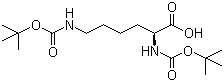 |
| Molecular Formula | C16H30N2O6 |
| Molecular Weight | 346.42 |
| Protein Sequence | X |
| CAS Registry Number | 2483-46-7 |
| EC Number | 692-009-7 |
| SMILES | CC(C)(C)OC(=O)NCCCC[C@@H](C(=O)O)NC(=O)OC(C)(C)C |
| Density | 1.1±0.1 g/cm3 Calc.* |
|---|---|
| Boiling point | 514.4±45.0 °C 760 mmHg (Calc.)* |
| Flash point | 264.9±28.7 °C (Calc.)* |
| Index of refraction | 1.478 (Calc.)* |
| * | Calculated using Advanced Chemistry Development (ACD/Labs) Software. |
| Hazard Symbols |  GHS07 Warning Details | ||||||||||||||||||||
|---|---|---|---|---|---|---|---|---|---|---|---|---|---|---|---|---|---|---|---|---|---|
| Risk Statements | H315-H319-H335 Details | ||||||||||||||||||||
| Safety Statements | P261-P264-P264+P265-P271-P280-P302+P352-P304+P340-P305+P351+P338-P319-P321-P332+P317-P337+P317-P362+P364-P403+P233-P405-P501 Details | ||||||||||||||||||||
| Hazard Classification | |||||||||||||||||||||
| |||||||||||||||||||||
| SDS | Available | ||||||||||||||||||||
 chemBlink Chemical Story
|
(S)-2,6-Bis-tert-butoxycarbonylaminohexanoic acid is more readily recognized as Nalpha,Nepsilon-di-Boc-L-lysine, or Boc-Lys(Boc)-OH. Lysine has an amino group next to its carboxyl group and another at the far end of a four-methylene side chain. In this derivative both nitrogens carry tert-butoxycarbonyl protection, while the acid remains available. The two Boc groups have the same basic chemical type, even though they occupy different sites. That arrangement is useful when the free carboxylic acid is the intended point of attachment. Both amino functions can be kept masked while the acid is coupled into another structure. Later removal of the Boc groups can reveal two amino functions on the attached lysine unit. Unlike a derivative bearing two deliberately different protecting groups, this molecule does not encode a simple orthogonal choice between the alpha and epsilon nitrogens. One should not assume that a condition removing one Boc will invariably leave the other untouched. A documented example appears in patent chemistry describing lysine-based dendritic assemblies. Repeated attachment of di-Boc-protected lysine, followed by exposure of its amino groups, can create additional branch points. The patent's experimental schemes show the protected lysine being used in successive growth stages on a PEG-containing framework. This is evidence of synthetic construction in the disclosed examples; it does not validate a therapeutic effect of the protected amino acid or every resulting dendrimer. The geometry of lysine helps explain the branching logic. An attached carboxyl end can lead to two amino sites that are separated by the amino-acid framework. Each new branch can then offer further coupling opportunities when appropriately activated partners are supplied. Repeating such steps generates an architecture different from a single linear peptide sequence. The exact number of branches still depends on conversion and the purity of the intermediates. Its structural name also preserves the S configuration at the amino-acid center. Protection does not erase that center or make all later reactions stereochemically inconsequential. The reagent's meaningful role is therefore controlled access to one acid now and two amino groups later, with a defined lysine skeleton linking them. That is a construction strategy, not a claim about the biological properties of the temporary protected form. References: 1. Thermo Fisher Scientific. Nalpha,Nepsilon-di-Boc-L-lysine, CAS 2483-46-7, SDS. https://static.cymitquimica.com/products/02/pdf/sds-H62019.pdf 2. Patent JP2013500950A. Biodegradable polyethylene glycol water-insoluble hydrogel; lysine construction examples. https://patents.google.com/patent/JP2013500950A/en |
| Market Analysis Reports |