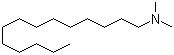
N,N-Dimethyltetradecylamine looks like a conventional long-chain tertiary amine: a C14 hydrophobic tail attached to a nitrogen bearing two methyl groups. Yet one proton can change its behavior dramatically. In the neutral state the molecule is poorly compatible with water. Protonate the nitrogen and it becomes a positively charged ammonium species with a hydrophilic head and a long hydrophobic tail - in other words, a cationic surfactant.
That reversible acid-base step has been turned into a chemical switch. In CO2-responsive systems, carbon dioxide dissolves in water and, through carbonic acid equilibria, helps protonate the tertiary amine. The neutral oil-like molecule is converted into an ionic amphiphile that can lower surface tension, stabilize interfaces, and generate foam. Remove the CO2, for example by sweeping with nitrogen or changing conditions, and deprotonation shifts the material back toward its less water-soluble neutral form.
Poole and co-workers studied this behavior directly for C14DMA. They found that the neutral form was essentially water-insoluble and not appreciably surface-active, whereas exposure to CO2 produced a cationic surfactant capable of foaming. Displacing CO2 with N2 turned the surface activity down again. The experiment is striking because no covalent bonds in the long hydrocarbon skeleton need to be broken or rebuilt; changing protonation is enough to reorganize the macroscopic behavior of the liquid.
Switchable surfactants are attractive wherever a surfactant is useful during one processing step but troublesome afterward. Conventional surfactants can be difficult to remove because the same property that stabilizes an emulsion also prevents phases from separating. A switchable amine can help form an emulsion, foam, or dispersion and then be converted to a less surface-active form to assist recovery, separation, or recycling. Whether a particular process is practical depends on pH, salt content, temperature, CO2 pressure, kinetics, and the materials being handled.
Long-chain tertiary amines are also versatile chemical intermediates. Quaternization gives permanently charged ammonium salts, while oxidation can give amine oxides; both families are important in surfactant chemistry. N,N-Dimethyltetradecylamine therefore sits at a useful branching point between a neutral base, a reversible ammonium surfactant, and derivatives with permanent or differently expressed amphiphilicity.
The memorable lesson is that surface activity can be switched by acid-base chemistry. A single proton changes the nitrogen from neutral to charged and converts a hydrophobic amine into an amphiphile. N,N-Dimethyltetradecylamine shows how molecular-scale proton transfer can control macroscopic properties such as foaming, interfacial tension, and phase separation.
References:
1. Poole A.J. et al. Foaming and defoaming properties of CO2-switchable surfactants. Journal of Surfactants and Detergents. 2022. DOI: 10.1002/jsde.12597.
2. Jessop P.G., Mercer S.M., Heldebrant D.J. CO2-triggered switchable solvents, surfactants, and other materials. Energy & Environmental Science. 2012, 5, 7240-7253. DOI: 10.1039/C2EE02912J.
3. PubChem and regulatory identity records for N,N-dimethyltetradecylamine, CAS 112-75-4.
4. General surfactant chemistry literature on tertiary amine protonation, quaternization, and amine oxides.
|






 GHS05;GHS07;GHS09 Danger Details
 chemBlink Chemical Story