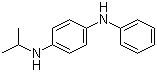
N-Isopropyl-N'-phenyl-1,4-phenylenediamine, commonly known as IPPD or Antioxidant 4010NA, is a p-phenylenediamine antidegradant developed to protect natural and synthetic rubber against some of its most persistent enemies: oxygen, ozone, heat, and repeated mechanical flexing. Its importance illustrates an often overlooked principle of polymer technology. Making a useful material is only half the challenge; preventing that material from slowly destroying itself during service can be equally important.
Rubber appears durable, but its molecular structure is inherently vulnerable to aging. Many elastomers contain carbon-carbon double bonds that provide useful flexibility but also create sites susceptible to oxidative attack. Oxygen, heat, ultraviolet exposure, and mechanical stress can initiate free-radical reactions that gradually alter the polymer chains. The material may harden, lose elasticity, discolor, or eventually crack.
Ozone presents an especially severe challenge. Although atmospheric ozone is present only at very low concentrations, it reacts rapidly with unsaturated rubber. When a rubber component is held under tension, ozone attack can produce characteristic cracks perpendicular to the direction of strain. Tires, hoses, belts, seals, vibration mounts, and other rubber articles may therefore deteriorate even when the amount of ozone in the surrounding air seems insignificant.
The rubber industry developed antidegradants to interrupt these processes. IPPD belongs to the substituted p-phenylenediamine, or PPD, family, whose members became particularly important because they can provide both antioxidant and antiozonant protection. Rather than forming an inert physical shield, these molecules participate directly in protective chemistry. They can intercept reactive species generated during oxidation and react readily with ozone, sacrificing themselves before the polymer network suffers equivalent damage.
This sacrificial chemistry explains an apparent paradox. An effective antidegradant is useful precisely because it is more willing to react than the material it protects. As IPPD is consumed, transformation products are formed, while additional IPPD within the rubber can migrate toward exposed regions. The additive therefore functions as a chemical defense system distributed throughout the rubber compound rather than simply as a surface coating.
IPPD has been used in natural rubber and several synthetic elastomers, including styrene-butadiene, nitrile-butadiene, butadiene, and chloroprene rubbers. Its protection against ozone cracking, oxidative aging, and fatigue made it valuable for tires and numerous industrial rubber goods. Like many highly active amine antidegradants, however, it can cause discoloration and staining, limiting its suitability where appearance is critical.
The history of PPD antidegradants has recently acquired a new environmental dimension. Tire wear releases complex mixtures of rubber particles and additives into roads, soils, and surface waters. Research following the identification of toxic transformation products from the related tire antioxidant 6PPD has stimulated broader investigation of the environmental behavior of the entire PPD family. Recent studies show that IPPD also reacts rapidly with ozone and produces numerous transformation products, emphasizing that chemicals designed to undergo protective reactions inside rubber can continue reacting after they enter the environment.
This does not erase the technological importance of PPD antidegradants. Rubber components used in transportation and infrastructure must resist premature cracking and failure, and extending material lifetime has important economic and safety benefits. Instead, the emerging environmental evidence presents modern materials science with a more demanding design problem: future antidegradants must protect rubber effectively while also minimizing hazards associated with their transformation products and environmental release.
IPPD therefore represents more than a traditional rubber additive. It demonstrates the concept of sacrificial molecular protection—using a deliberately reactive small molecule to defend a much larger polymer network. At the same time, its evolving story shows how chemical technologies are continually reassessed as science advances. A molecule once judged mainly by how well it preserved rubber is now also studied according to what happens to it after that protective job is finished.
References
1. Cataldo, F. (2001). "Ozone degradation of natural rubber." Polymer Degradation and Stability, 73(3), 511-520. https://doi.org/10.1016/S0141-3910(01)00120-8
2. Huang, W. et al. (2021). "Urban stormwater runoff mortality syndrome in coho salmon." Science, 371(6525), 185-189. https://doi.org/10.1126/science.abd6951
3. Tian, Z. et al. (2022). "A ubiquitous tire rubber-derived chemical induces acute mortality in coho salmon." Science, 371(6525), 185-189. https://doi.org/10.1126/science.abd6951
4. Chen, Z. et al. (2026). "Heterogeneous ozone oxidation of p-phenylenediamine antioxidants." Journal of Hazardous Materials, 507, 141745. https://doi.org/10.1016/j.jhazmat.2026.141745
|






 GHS07;GHS09 Warning Details
 chemBlink Chemical Story